

Plateau (Journal), Volume 24, Number 2: Hopi Pottery Firing Temperatures et al
$10.00
3 in stock
Description
Authors: Colton, Harold S. (1881-1970) (Hopi Pottery); Wendorf, Fred (1924-2015) (Twin Butte Site); Jackson, Robert L. (Supai Formation), and Judd, Neil M. (1887-1976) (Nampeyo)
Publisher: Northern Arizona Society of Science and Art (Museum of Northern Arizona, Flagstaff, AZ)
Pub Date: 1951
Binding: Paperback
Condition: 3 copies. Copy 1 (JDFP): Fair. Stapled binding tight. No tears, bends or folds. Previous owners’ stamp on upper front cover corner and on upper corner first and second pages. Sun-fading to front and rear spine edges. Light edge and corner wear. Copy 2 (JDFP): Fair. Stapled binding tight. No tears, folds. Previous owner’s stamp on upper front cover corner. Lower front cover corner bumped, extends through entire volume. Light edge wear. Copy 3 (JDFP): Fair. Stapled binding tight. No marks, tears, folds. Lower rear cover corner has an approx. 1″ bend, extends through entire volume. Slight sun-fading to front spine edge. Light edge wear.
Notes: Journal. Colton and the Museum of Northern Arizona invited seven Hopi women to demonstrate how their pottery is fired. “All materials needed, such as sheep dung, coal, sandstone fragments, and large potsherds were gathered on the Indian Reservation and brought to the grounds of the Museum.” (Page 73) The range of temperatures for seventeen firings ranged from 720°C (1328°F) to 885°C (1625°F). A potential problem–lack of sheep dung. Wendorf’s “The Twin Butte Site”, in the Petrified Forest National Monument, was a straightforward excavation over two seasons. “The ceramic components of the site could be divided into two main groups, one, gray in color, the other, brown…The mingling of ceramic traditions, often considered determinants of two different cultural patterns, the Anasazi (gray wares) and Mogollon (brown wares), is one of the most interesting features of the site.” (Page 81). Jackson’s “Supai Formation” essay concludes “The Supai formation of central Arizona is an advancing continental deltaic deposit of Pennsylvanian -Permian age which has caused a regression of the Pennsylvanian sea due to sedimentation exceeding subsidence in the area.” (Page 91). The final essay, “Nampeyo, An Additional Note”, by Neil Judd, helps determine more precisely the year of her birth and the circumstances that influenced her career as a potter.
You may also like…
-

Historic Hopi Ceramics: The Thomas V. Keam Collection of the Peabody Museum of Archaeology and Ethnology, Harvard University
$150.00 Add to cart -
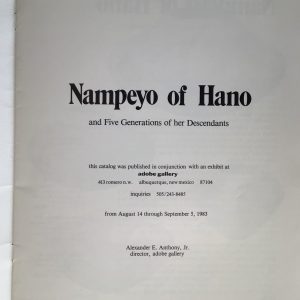
Nampeyo of Hano and Five Generations of her Descendants (Pamphlet)
$10.00 Add to cart -
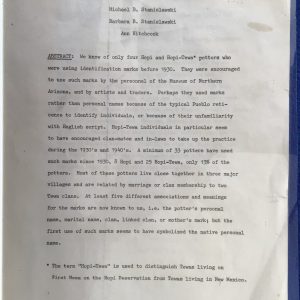
Identification Marks on Hopi and Hopi-Tewa Pottery (Pamphlet)
$15.00 Add to cart -

Talking with the Clay: The Art of Pueblo Pottery
$7.00 Add to cart -

Roadside Geology of Arizona
$7.00 Add to cart -
Ancient Landscapes of the Grand Canyon Region: The Geological Story of Zion, Bryce, Petrified Forest, Painted Desert and Grand Canyon
$5.00 Add to cart -
Designs on Prehistoric Hopi Pottery
$5.00 Add to cart -
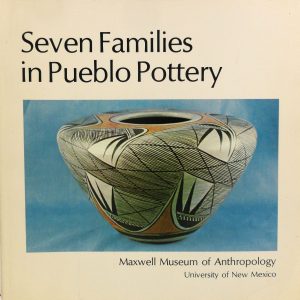
Seven Families in Pueblo Pottery
$5.00 Add to cart -
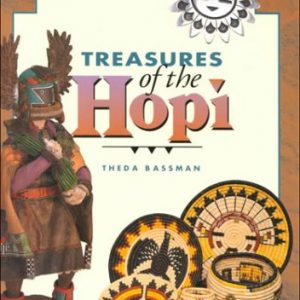
Treasures of the Hopi
$6.00 Add to cart
Related products
-

Pipeline Archaeology: Reports of Salvage Operations in the Southwest on El Paso Natural Gas Company Projects 1950-1953
$15.00 Add to cart -
Guide to the Geology of Mesa Verde National Park (Pamphlet)
$9.00 Add to cart -
Reprints in Anthropology Volume 23: The Material Culture of Pueblo Bonito
$30.00 Add to cart -

Pottery Types of the Arizona Strip and Adjacent Areas in Utah and Nevada: Museum of Northern Arizona Ceramic Series No. 1
$50.00 Add to cart