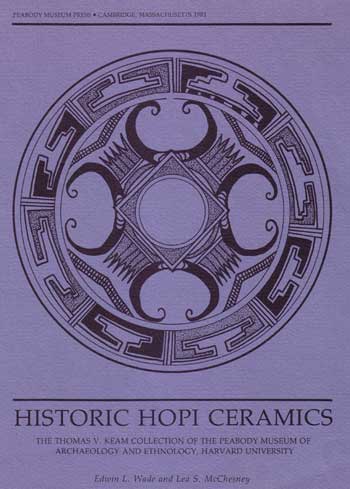
Historic Hopi Ceramics: The Thomas V. Keam Collection of the Peabody Museum of Archaeology and Ethnology, Harvard University
$150.00
1 in stock
Description
Authors: Wade, Edwin L. and McChesney, Lea S.
Publisher: Peabody Museum Press
Pub Date: 1981
Binding: Paperback
Condition: Fair. Ex-library, with a number of library markings. Library bookplate, pen markings and “Withdrawn” stamp on inside front cover. Library blindstamp on title page. Library checkout card pocket on inside rear cover. Label on foot of spine. There is an approx. 1″ tear at the upper front cover corner at the spine, extending approx. 1/2″ onto front cover. Edge and corner wear. Upper front cover corner has small bend which extends to the first few pages. Smudging to text block.
Notes: Thomas Keam was born in Kenwyn, England on August 6, 1842. He went to sea as a young man and served in several branches of the British and then American military. Honorably discharged at Santa Fe, New Mexico in 1868, Keam stayed on, becoming a licensed trader with the Indian Bureau. By 1879 he had left the trading post he and and William Leonard had established together, to what is now called Keam’s Canyon, Arizona. There he traded with both the Hopi and Navajos, learning both their languages fluently. His dealings with both tribes enabled his collecting of prehistoric Indian artifacts. The largest of his collections is housed with the Museum of Ethnology, while others can be found in a variety of institutions in the United States. Over 4,500 objects in the collection range from prehistoric pottery, baskets, and textile fragments to nineteenth-century ceremonial art. This book, a survey of the designs, stylistic development, and production techniques of historic Hopi pottery (A. D. 1540-1900) is based on the collection.