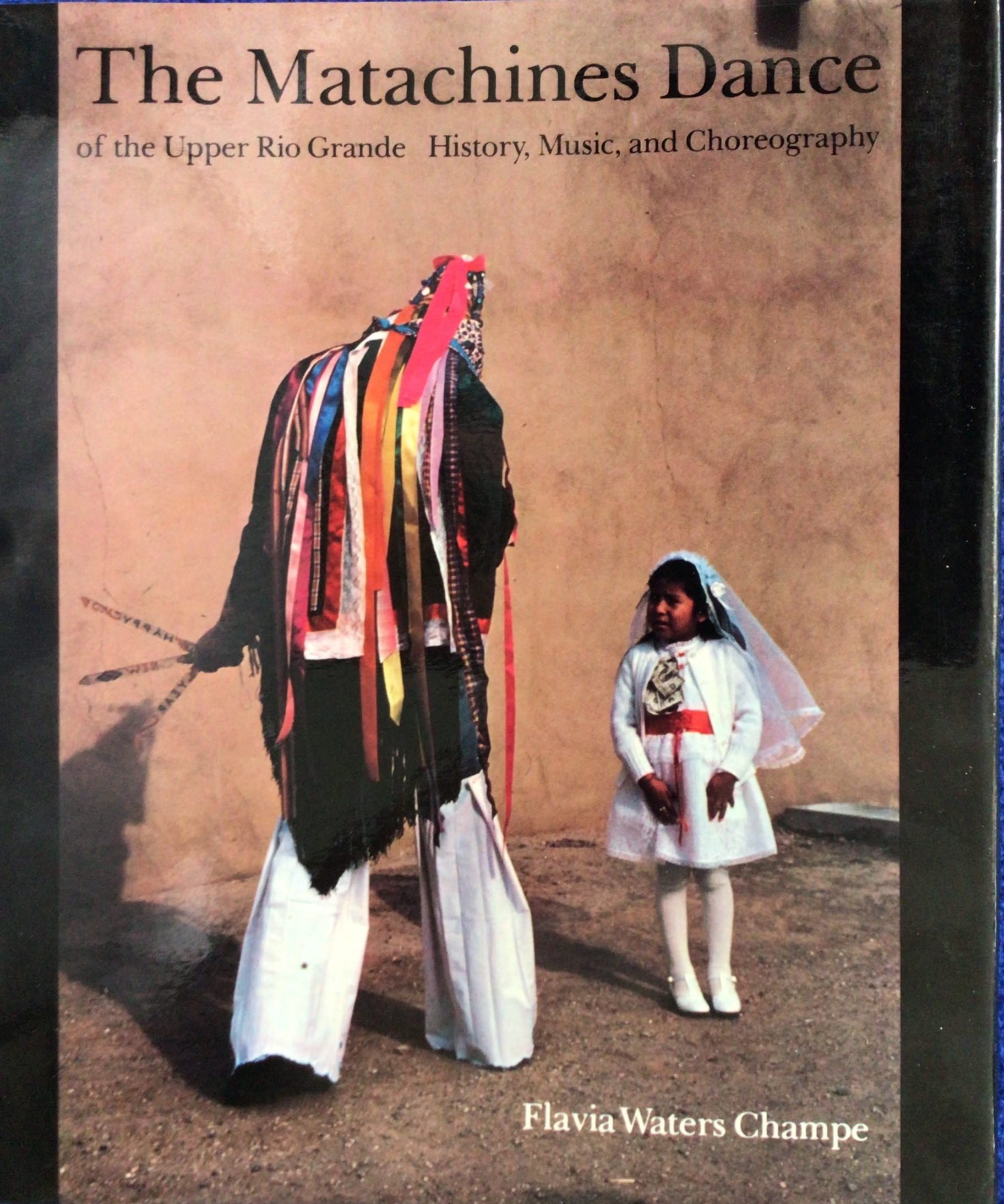
The Matachines Dance of the Upper Rio Grande: History, Music, and Choreography
$10.00
Sorry. I currently do not have another copy of this title. Please enter it on your wish list.
Description
Author: Champe, Flavia Waters (1902-1992)
Publisher: University of Nebraska Press
Pub Date: 1983
Binding: Hardcover
Condition: Book: Good. Binding tight. No marks, tears, bends or folds. Gilt on spine still sharp (I’d say easily readable but it’s a gold gilt on the yellow board, so, not so much). Very light edge and corner wear. Dust Jacket: Good. NOT price clipped (no price indicated). Very light edge and corner wear. Includes a flexible record of Matachine dance music in a pocket at rear (if you have a record player…). Illustrated with photographs and choreography diagrams.
Notes: The Matachines dance in New Mexican pueblos (San Ildefonso, San Juan, Santa Clara, Taos, Jemez, Picuris) and some towns/villages (Bernalillo, Alcalde) on Christmas Day, and other days associated with religious feast days or saint’s days. The ceremony itself has an uncertain genealogy. Some of the New Mexican tribes say that Montezuma himself taught the dance to their ancestors–the character El Monarca (the King) seems to bear out that theory, Los Capitanes (the leaders, the four corners), Los Matachines (the men who dance together as a group, usually 12, including Los Capitanes ), La Malinche, the only female dancer in the production, a small girl dressed all in white (Malinche was the Indian woman who served as interpreter, adviser, and mistress to Cortés) who may or may not represent the Virgin Mary (grain of salt time), El Abuelo (grandfather), a clown role and master of ceremonies, and El Toro (the bull), using a bull fight as another comic element , usually portrayed by a young boy, and the Viejos, or assistants. Need help? It’s complicated, historical, ceremonial folklore.
You may also like…
-
Ceremonial Costumes of the Pueblo Indians: Their Evolution, Fabrication, and Significance in the Prayer Drama
$90.00 Add to cart -

This Is the Sun Dance (pamphlet)
$5.00 Add to cart -

Children of Cottonwood: Piety and Ceremonialism in Hopi Indian Puppetry
$20.00 Add to cart -

On Hawaiian Folk Music
$6.00 Add to cart -

Hopi Music and Dance
$10.00 Add to cart -

Enemy Way Music: A Study of Social and Esthetic Values as Seen in Navaho Music
$80.00 Add to cart
Related products
-

Pueblo Designs: 176 Illustrations of The “Rain Bird”
$6.00 Add to cart -

Portraits of “The Whiteman”: Linguistic play and cultural symbols among the Western Apache
$4.00 Add to cart -

Prehistoric Weapons in the Southwest (Pamphlet)
$6.00 Add to cart -

American Indian and Eskimo Basketry: A Key to Identification
$8.00 Add to cart