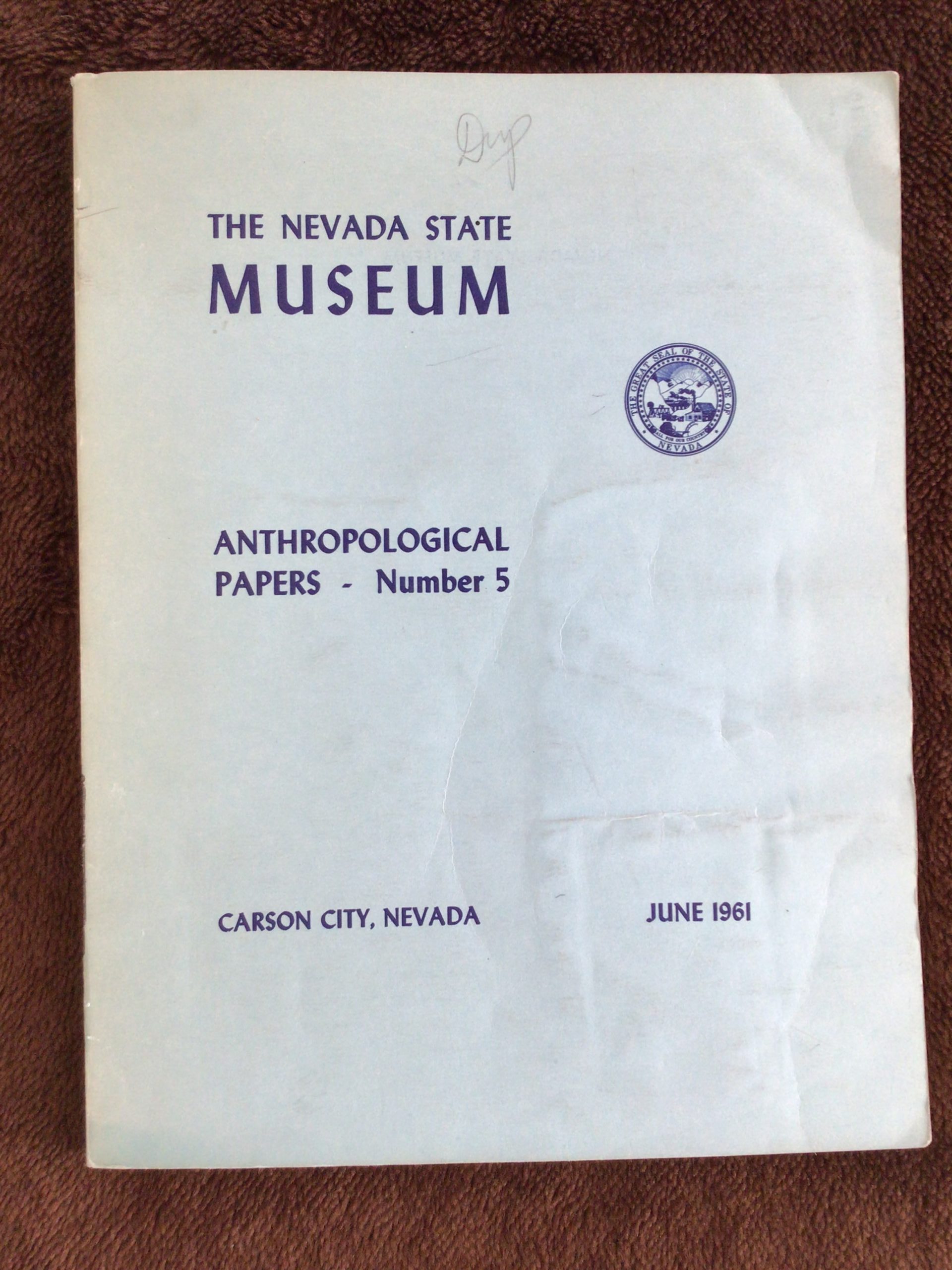
The Nevada State Museum Anthropological Papers–Number 5: Lost City: Pueblo Grande de Nevada
$30.00
“Pueblo Grande de Nevada, more popularly known as “Lost City,” refers to a loosely defined series of archaeological sites in the Moapa Valley of southern Nevada. Excavated between the years of 1924 and 1941, these sites were to have a major impact on early-twentieth-century Southwestern archaeology. Despite the excitement that surrounded these finds at the time of their discovery, their legacy has largely been forgotten today. We argue one reason for this oversight is that the data obtained by the original researchers are inadequate for addressing the questions being asked of the region today. In particular, because plant and animal remains were not systematically recovered by the original researchers, the early fieldwork has provided only a broad sketch of the subsistence activities practiced in the region. To remedy these shortcomings, in 2006 archaeologists from the University of Nevada Las Vegas conducted additional excavations at House 20, a roomblock located within one of the so-called Lost City sites. In this paper, the history of the Lost City fieldwork is reviewed and results from our 2006 excavations are presented. The newly obtained data suggest that the inhabitants of House 20 were heavily invested in agriculture and utilized wild resources that could be obtained in the immediate vicinity.” Kiva, Volume 74, No. 4 (Summer 2010)
2 in stock
Description
Author: Shutler, Jr., Richard (1921-2007)
Publisher: Nevada State Museum
Pub Date: 1961
Binding: Paperback
Condition: 2 copies. Copy 1: Fair. Ex-library. Stapled binding tight. No tears. The ex-library markings include stamping to all three text blocks, and check out card envelope and “Date Due” remnants on inside front cover, creating wrinkling to front cover. Pencil marking “Dup” on upper front cover. Library markings on spine blacked out by marker. Smudge to upper rear cover. Some library pencil marks throughout. Edge and corner wear. Copy 2 (LC): Fair to Good. Binding tight. No tears. Ex-library. “Cancelled” stamp from Peabody Museum Library in red on front cover. Second previous owner’s stamp on upper front cover corner. One approx. 1/2″ crease at lower front cover corner. One spot on rear cover.
Notes: The Nevada State Museum Anthropological Papers Number 5. Shutler’s revised doctoral dissertation. “The name Pueblo Grande de Nevada, or Lost City, refers to the archaeological sites that lie along both sides of the lower 16 miles of the Muddy River. These sites, several hundred in number, are composed of pithouses, pueblo ruins, campsites, rockshelters, salt mines and caves.” (from the Preface). According to Colton the Lost City represents three phases of occupation–the Virgin Branch (A.D. 600-A.D. 900), the Lost City Phase (Pueblo II, A.D. 900-1100), and the Mesa House Phase (late Pueblo II or early Pueblo III, A.D. 1100-1150). The author proposed four phases, beginning with Basketmaker II, with an undetermined beginning date to about A. D. 500, the Muddy River Phase (A.D. 500 to 700), the Lost City Phase from A.D. 700-1100, and the Mesa House Phase (A.D. 1100-1150). Aside from the library markings, my single complaint about this volume is the type size. That MIGHT be offset by the overall number of plates (85 pages of text, 85 pages of photographs). VERY RARE in this edition. No copies available.