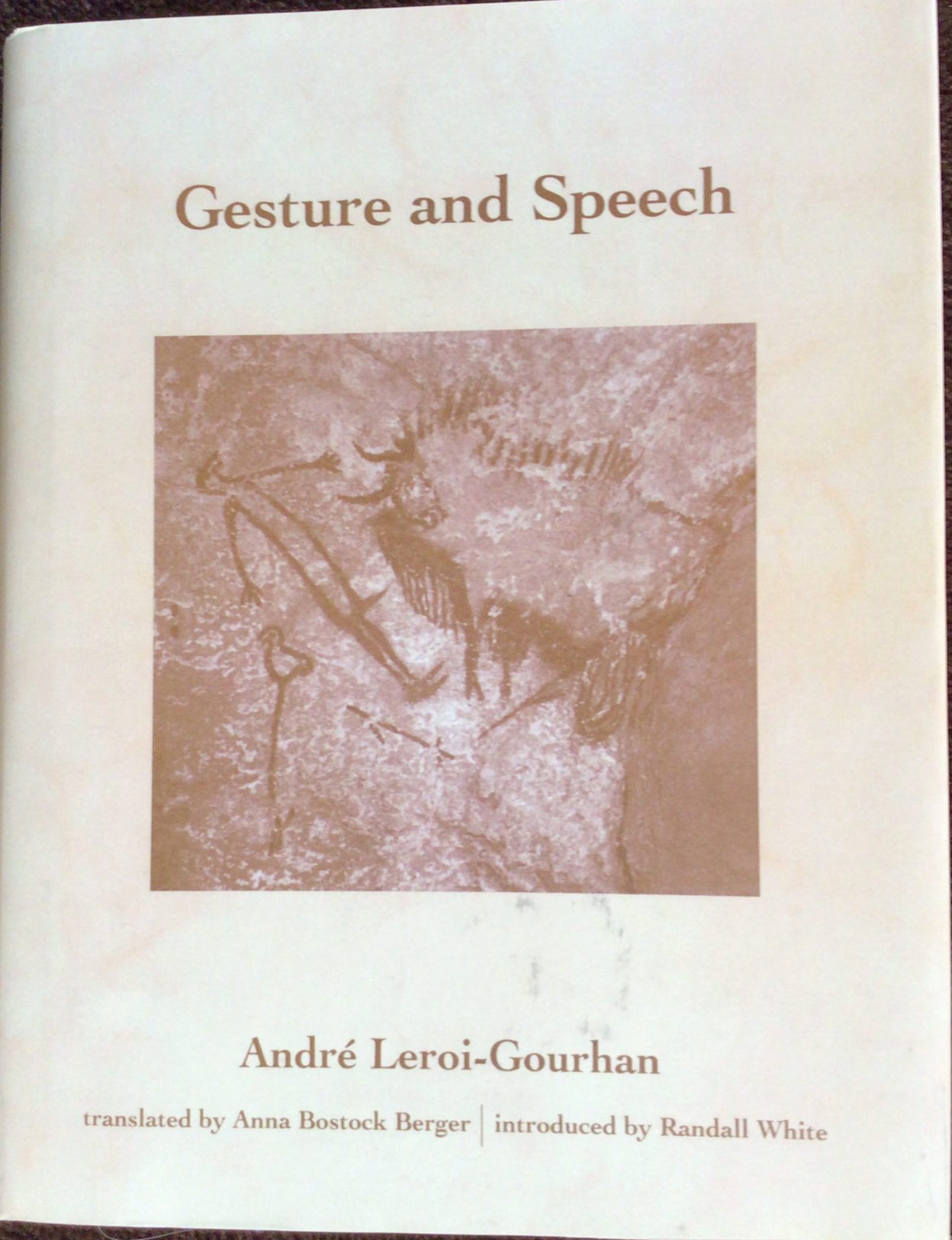
Gesture and Speech
$40.00
1 in stock
Description
Author: Leroi-Gourhan, André (1911-1986)
Publisher: MIT Press
Pub Date: 1993 (Reprint edition, Third printing)
Binding: Hardcover
Condition: Book: Fair. Binding tight. No tears, bends or folds. Previous owner’s name and mark on upper corner title page, near spine head. Very light edge and corner wear. Dust Jacket: Fair to Good. NOT price clipped (no price indicated). Smudging to front cover. Front cover bottom edge has an approx. 2″ long area where it feels rough, raised. It’s not torn or bent, just rough. Wear to spine head.
Notes: Originally published in French in 1964, translated into English by Anna Bostock Berger. “…combines in one volume Technics and Language and Memory and Rhythms.” Thinking-man’s archaeological theory–functional evolution. “….against the background of the vast documentation assembled by study of the paleontology and biology of vertebrates we can attempt to sketch out a function paleontology. To do this, we must include within a single perspective the main functional elements of each of the types that succeeded one another over the ages. For purposes of convenience the number of these elements may be reduced to five. The first pertains to the constraints of locomotion–to the mechanical organization of the vertebral column and the limbs. This element is indissociable from those that follow because the organs of motion are the driving gear of the way of life. The second element is the suspension of the skull. Because of the skull’s topographical location, this is the most sensitive element of the function apparatus; this fact has been empirically understood since the very beginnings of paleontology…The next element is dentition, whose connection with the way of life can be readily understood if we take into account the role played by the teeth in defense and in capturing and preparing food. The fourth element is the hand, or at any rate the extremity of the forelimb, and its possible integration with the technical field. Lastly, the fifth element is the brain, whose role as coordinator is obviously a primordial one but which functionally appears as the ‘tenet’ of the rest of the body. This situation of the brain, which could be described as subordinate to the edifice as a whole…” (Pages 36-37) So, if we’re going to talk about how modern man came to be, let’s start at the beginning.
You may also like…
-

The River That Flows Uphill: A Journey from the Big Bang to the Big Brain
$8.00 Add to cart -

Synergetics: Explorations in the Geometry of Thinking
$20.00 Add to cart -
A Brief Description of the Tewa Language (Pamphlet)
$20.00 Add to cart -

Finding Our Tongues: Mothers, Infants and the Origins of Language
$8.00 Add to cart -

Critical Path
$15.00 Add to cart -

Carib-Speaking Indians: Culture, Society and Language
$18.00 Add to cart -
On Phonetic and Lexic Resemblances Between Kiowan and Tanoan (Pamphlet)
$12.00 Add to cart -
Linguistic Diversity among the Navaho Indians (Pamphlet)
$10.00 Add to cart -

An Introductory Paper on the Tewa Language, dialect of Taos, New Mexico (Pamphlet)
$15.00 Add to cart -

Flutes of Fire: Essays on California Indian Languages
$8.00 Add to cart -

The Brain in Homind Evolution
$6.00 Add to cart -

An Ethnologic Dictionary of the Navajo Language
$250.00 Add to cart -

Anthropological Papers #101: Cochimí and Proto-Yuman: Lexical and Syntactic Evidence for a New Language Family in Lower California
$13.00 Add to cart