The Concept of Type in American Archaeology
$10.00
1 in stock
Description
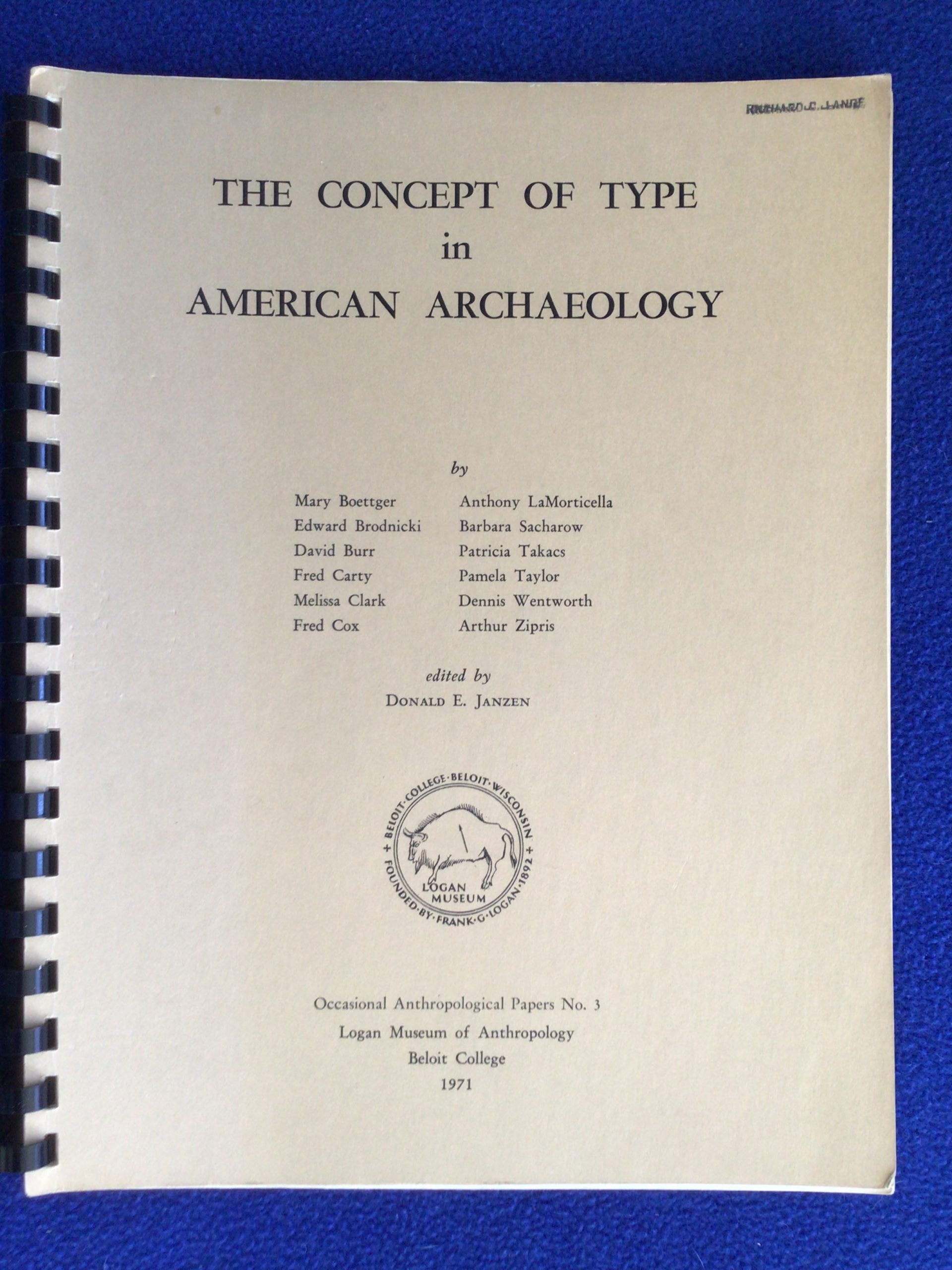
Editor: Janzen, Donald E.
Publisher: Logan Museum of Anthropology, Beloit College
Pub Date: 1971
Binding: Paperback (comb binding)
Condition: Fair to Good. Comb binding tight, no missing or broken teeth. No tears. Previous owner’s stamp on upper corner front cover and inside front cover, and attempted on all three text blocks (smaller stamp or bigger text block necessary for this to work). One long crease on rear cover, from top to bottom.
Notes: Occasional Anthropological Papers No. 3. Janzen, the editor, takes portions of twelve student papers to define the concept of “type” (or “typology”). “A review of the literature indicates that discussions of typology usually assume that the archaeologist has some intuitive means of selecting the defining criteria for types. Obviously this is not true; therefore, I would like to state explicitly what guidelines I believe should be followed. If a population of similar artifacts is to be arranged into groups, i.e. typed, at least four guidelines should be followed in selecting the defining criteria. First, the criteria should be mutually exclusive so there is no possibility that one artifact can belong to two types. Next, the criteria should be empirically observable or objectively definable so that different archeologists observing the same data will generate similar groupings…A third guideline for selecting defining criteria is to use frequently-occurring items. If a classification depends on the presence of an item that is rarely found, then in most cases it will be impossible to generate a typology…Finally, it should be possible to quantify the defining criteria. A typology which states that Type A is larger than Type B should specify exactly how much larger.” (From the Introduction)