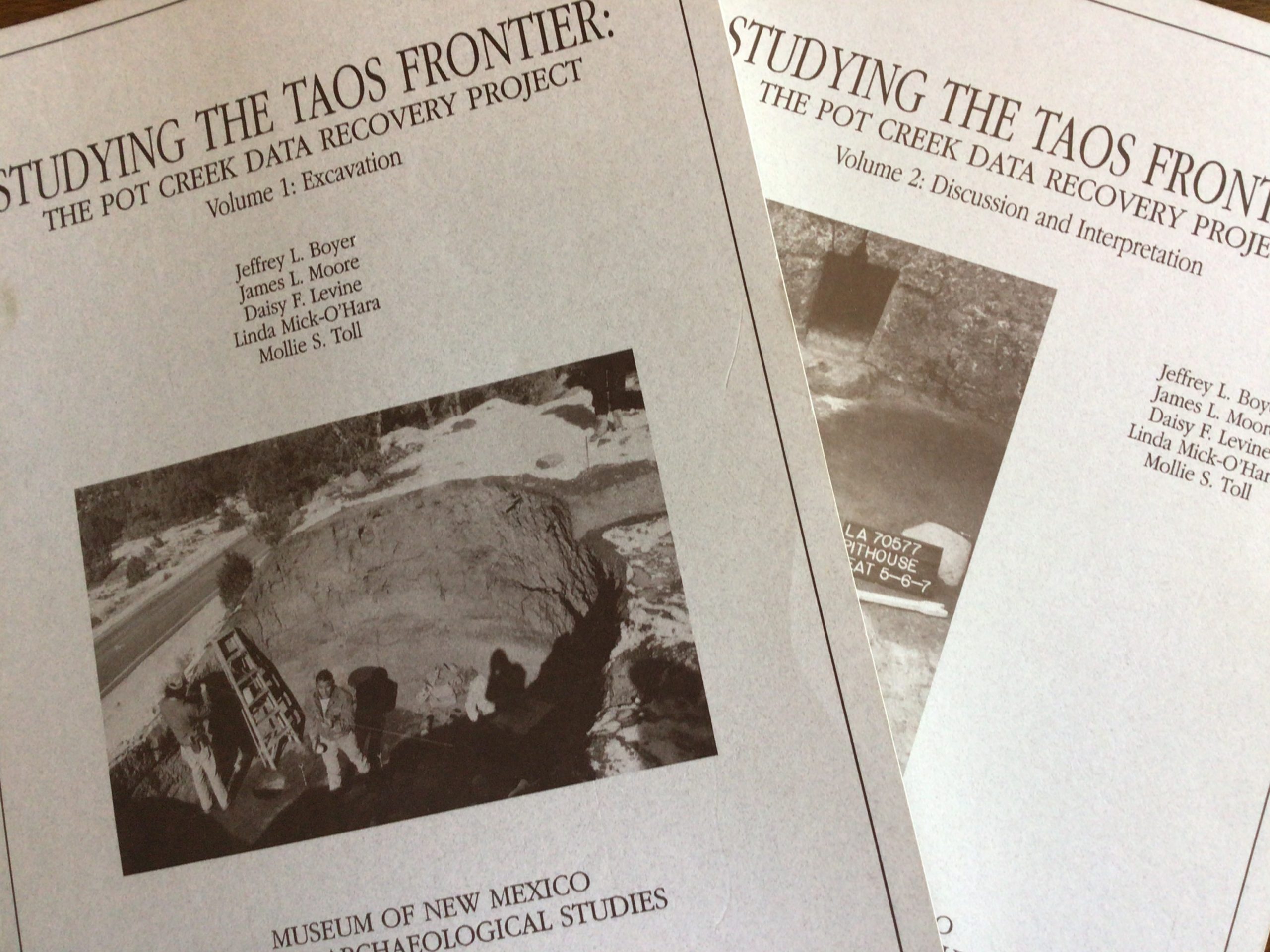

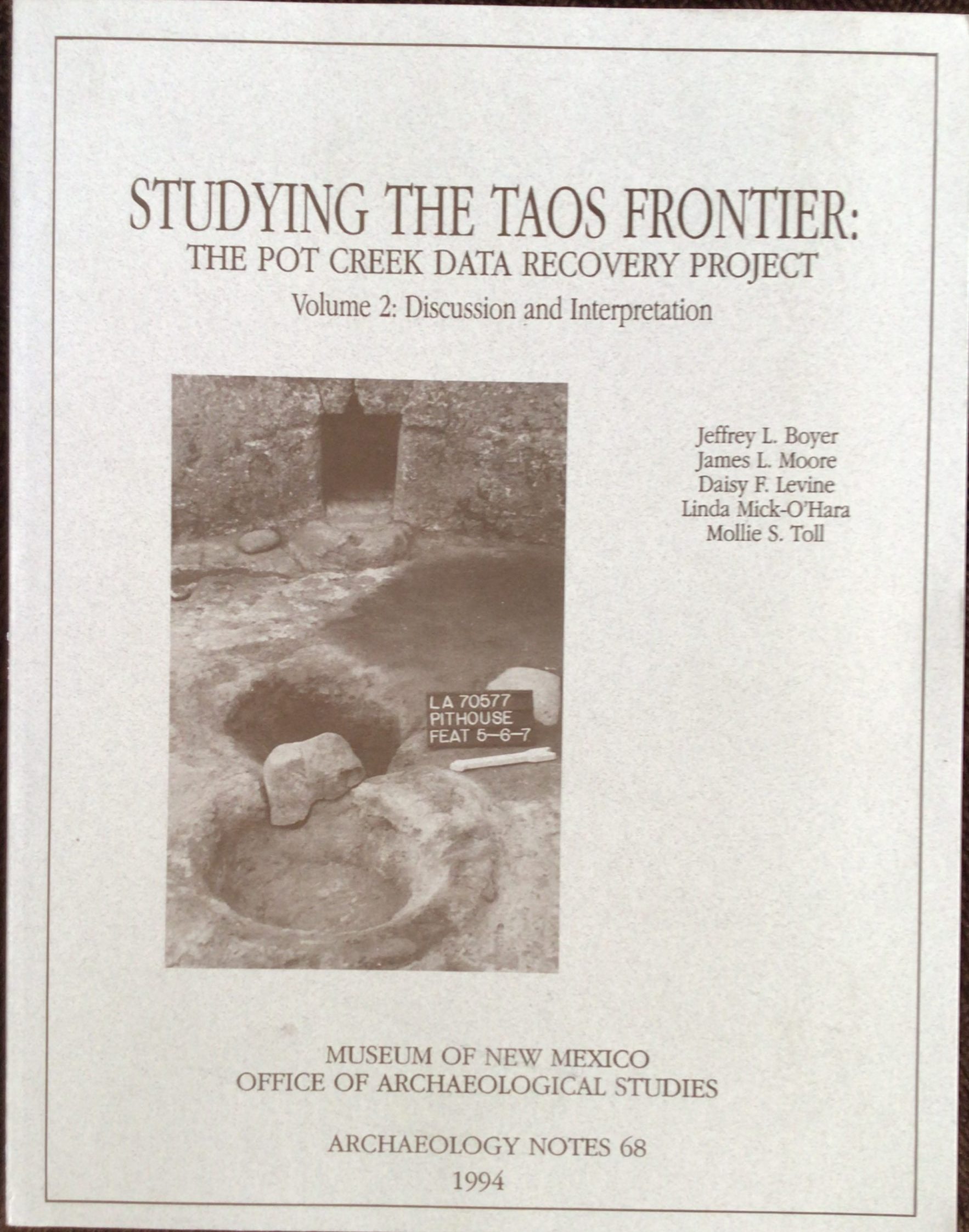
Studying the Taos Frontier: The Pot Creek Data Recovery Project (Two Volume Set)
$80.00
2 in stock
Description
Authors (both volumes): Boyer, Jeffrey L.; Moore, James L.; Levine, Daisy F.; Mick-O’Hara, Linda; and Toll, Mollie S.
Publisher: Office of Archaeological Studies, Museum of New Mexico
Pub Date: 1994
Binding: Paperback
Condition: 2 sets. Set 1 (JR): Volume 1: Fair to Good. Binding tight. No marks, tears, bends or folds. Includes 7 fold-outs. Very light edge and corner wear. Table of Contents only in Volume 1. Appears unused. Volume 2: Fair to Good. Binding tight. No marks, tears, bends or folds. Includes 2 fold-outs. Very light edge and corner wear. Appears unused. Set 2 (D): Volume 1: Fair. Binding tight. No marks, tears, folds. Lower rear cover corner has an approx. 1/4″ bend. Some smudges to front and rear covers. Includes 7 fold-outs. Light edge wear. Volume 2: Good. Binding tight. No marks, tears, bends or folds. Includes 2 fold-outs. Very light edge and corner wear. Appears unused.
Notes: Archaeology Notes 68. Two volume set. SOLD AS A SET ONLY. Volume 1: Excavation. Investigations of six sites along NM Highway 518, prior to reconstruction of the road. “The sites included two prehistoric pithouse sites, a site that once included a pithouse, two prehistoric farming area represented by artifact scatters, and a multicomponent artifact scatter. The three pithouse sites dated to the Valdez phase (A.D. 1100-1225) of the Rio Grande Developmental period. The prehistoric farm sites dated to the Pot Creek phase (A.D. 1225-1270) of the Rio Grande Coalition period. The sixth site had a prehistoric Valdez-phase component and a historic late-nineteenth-century component” (From the Administrative Summary). Volume 2: Discussion and Interpretation: “In occupying the Taos Frontier, we showed that the Anasazi occupation began ‘suddenly’ about A.D. 1100. Obviously, this is a relative term because we do not know when the first pithouse was built in the Taos Valley. However, chronometric data show that the sites from the Valdez phase, the first identifiable as Anasazi, appear in the A.D. 1100s. There is no evidence to suggest a local Anasazi development from an earlier Basketmaker population…Finally, the notion of an immigrant population is supported by faunal analysis. Faunal assemblages from this project show an emphasis on small mammals and turkeys and intensive utilization of deer remains. This pattern is consistent with the actions of an agricultural population whose abilities to engage in hunting trips for big game were limited and who focused on procuring animal species found in and near their homes and farming areas.” (pages 459-460). No other copies of the set available for sale.
You may also like…


Related products
-

Soil, Water, Biology, and Belief in Prehistoric and Traditional Southwestern Agriculture
$22.00 Add to cart -

Archeological Test Excavations at LA 16769
$6.00 Add to cart -

Discoveries in Ancient Life: Paleontology–The Study of Fossils
$10.00 Add to cart -
An Analysis of Variability and Condition of Cavate Structures in Bandelier National Monument
$14.00 Add to cart